

A lower electricity bill sounds appealing, but the way you get there can make a big difference over the next 20 years.
I always think it is worth looking beyond the advertised monthly payment because the cheapest option today is not always the one that saves the most later.
That is exactly why many homeowners compare leasing solar panels with buying before signing a contract.
While a lease keeps upfront costs low and shifts much of the maintenance to the provider, it also limits ownership benefits and long-term financial returns. Buying usually demands a larger initial investment but can deliver greater savings over time.
Understanding how each option works makes it much easier to choose the one that fits your budget, future plans, and overall financial priorities.
Understanding Your Solar Financing Options
There are four common ways to pay for solar: a lease, a Power Purchase Agreement (PPA), a solar loan, or a cash purchase, and each one shifts risk and reward differently.
With a lease, you pay a fixed monthly fee to use panels a solar company owns and maintains. A PPA works similarly, except you pay per kilowatt-hour produced instead of a flat rate.
A solar loan lets you finance the system through a bank or the installer while owning the panels from day one.
A cash purchase means paying outright with no financing cost. That ownership question matters most: leasing and PPA customers never hold title, so the provider claims tax benefits and incentives, while loan and cash buyers keep the federal solar tax credit and any state-level rebates.
Understanding How Solar Panel Leasing Works
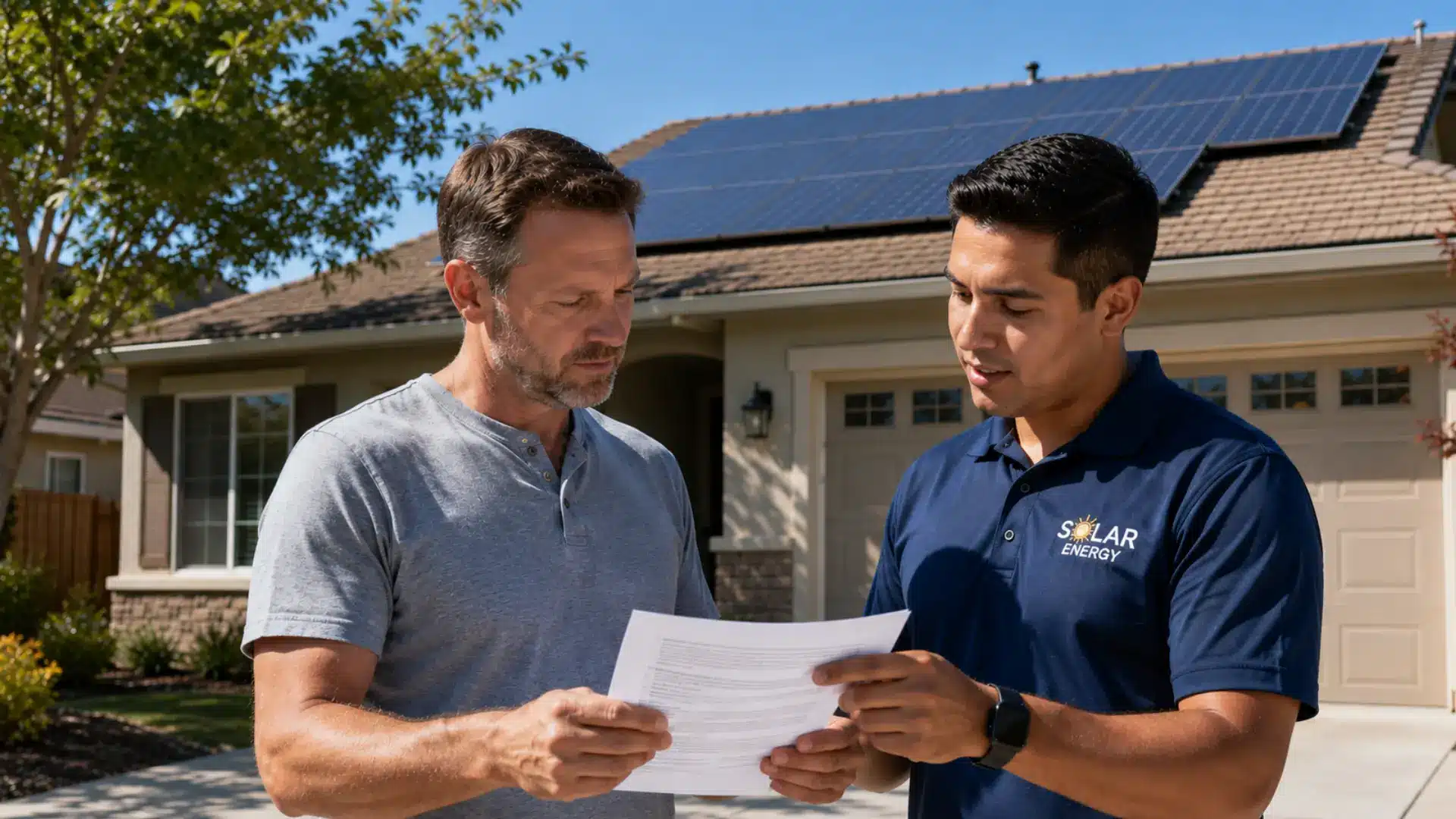
Leasing solar panels means the provider owns and maintains the system while you pay a monthly fee for the electricity it produces.
Most leases last 15 to 25 years, with savings depending on energy output, utility rates, and annual payment increases.
What Is a Solar Panel Lease?
A solar lease is a contract in which a solar company installs panels on your property but retains ownership of them. You pay a set monthly amount for the right to use the electricity the system produces.
Contracts typically run 20 to 25 years, matching the expected productive lifespan of the panels, and monthly payments are usually structured to be lower than what you’d otherwise pay your utility for the same amount of power.
How Leasing Solar Panels Works
The process generally follows a consistent sequence:
- Home evaluation: the provider assesses your roof’s condition, orientation, shading, and your historical electricity usage to size a system.
- System design: panel count, placement, and equipment are finalized based on that evaluation.
- Installation: the company’s crew mounts the panels, inverters, and wiring, typically over one to a few days.
- Utility connection: the system is inspected and connected to the grid, often requiring utility approval before it can go live.
- Monthly lease payments begin: you’re billed the agreed flat rate, regardless of how much energy the system actually produces in a given month.
- Utility bill after installation: you’ll likely still receive a (much smaller) bill from your utility for any grid electricity used beyond what your panels supply, plus the lease payment itself.
- Maintenance responsibilities: repairs, monitoring, and equipment servicing remain the provider’s job for the length of the contract, since they own the hardware.
Solar Lease vs. Power Purchase Agreement (PPA)
The two third-party ownership models look similar on the surface, but they differ in how your payment is calculated.
| Feature | Solar Lease | Solar PPA |
|---|---|---|
| Payment | Fixed monthly fee | Pay per kWh produced |
| Ownership | Solar company | Solar company |
| Monthly cost | Predictable | Depends on production |
| Maintenance | Provider | Provider |
| Tax credits | Provider | Provider |
The practical difference comes down to predictability versus variability. A lease payment stays the same whether it’s a sunny July or a cloudy December.
A PPA payment tracks actual output, so it can be lower in weak-production months and higher in strong ones, which suits homeowners who’d rather pay for what they get than for a flat guarantee.
Is It Better to Buy or Lease Solar Panels?
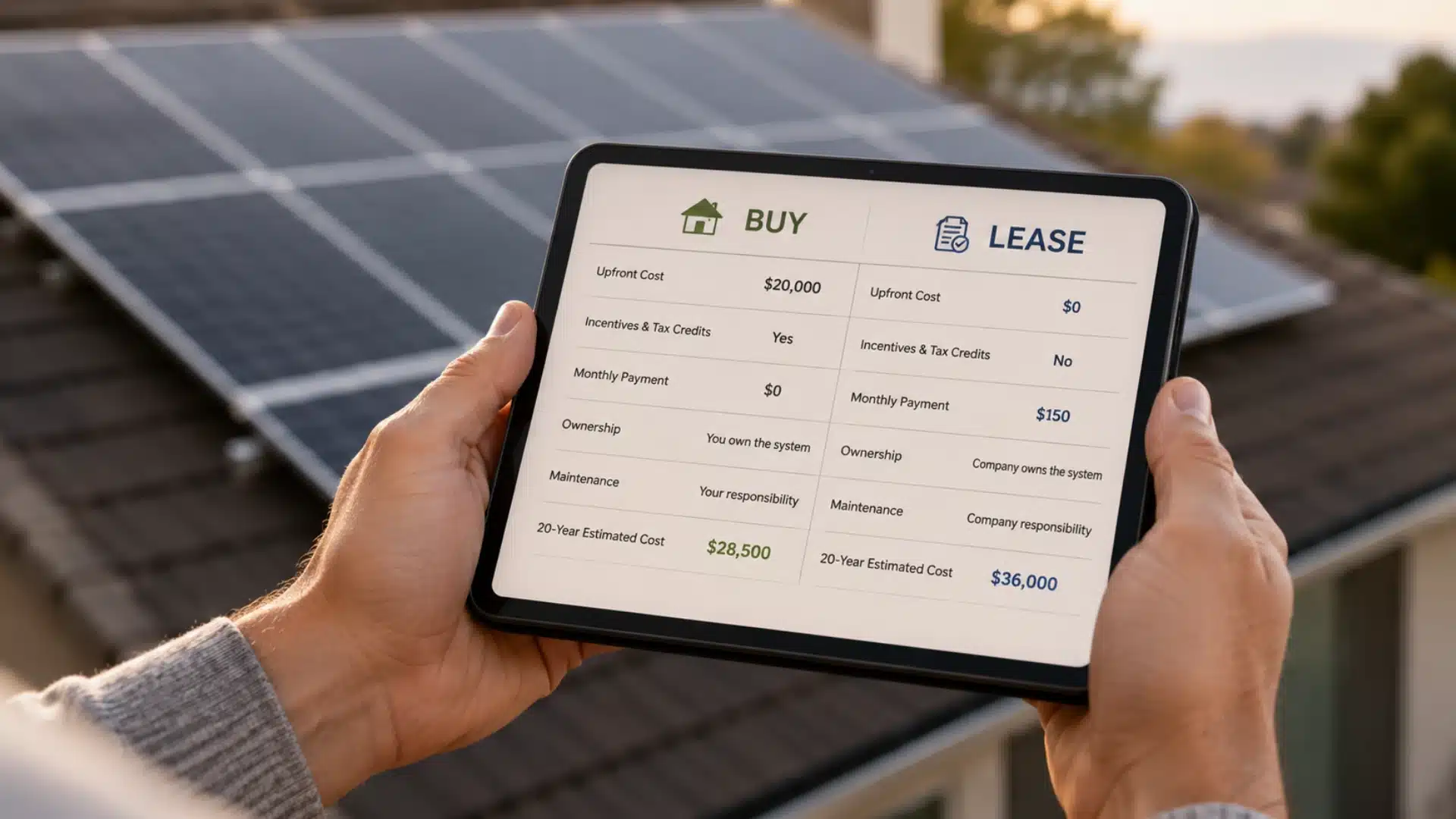
Buying offers greater savings and tax benefits, while leasing lowers upfront costs and maintenance.
Under a lease, the provider owns the panels, which limits savings and tax benefits and determines eligibility for federal solar incentives and ownership rules.
Buying and leasing solar panels lead to very different long-term costs, tax benefits, and ownership responsibilities. Here’s how they compare:
When Buying Makes More Sense
Purchasing, whether with a loan or cash, tends to pay off best for homeowners who plan to stay put and want to maximize returns over the life of the system.
- Long-term savings: once a loan is paid off (or immediately, if paid in cash), your only ongoing cost is minimal maintenance, no monthly payment at all.
- Tax credits: only owners can claim the federal solar tax credit and most state incentive programs.
- Home value: an owned solar system is typically treated as a home improvement that can add to resale value, since it transfers with the house free and clear.
- Ownership benefits: you control decisions about repairs, upgrades, or adding battery storage later.
- Loan vs. cash: a loan spreads the cost out with interest but still delivers ownership benefits from day one, while cash avoids financing costs entirely at the expense of a larger upfront outlay.
When Leasing Is the Better Choice
Leasing tends to fit homeowners prioritizing simplicity and low upfront risk over maximum lifetime savings.
- Low upfront investment: little to no money down to install panels.
- Maintenance included: repairs and monitoring are the provider’s responsibility, not yours.
- Budget limitations make solar accessible to homeowners who can’t finance a purchase or don’t want a loan.
- Predictable payments: a flat monthly fee is easy to budget around.
- Short-term affordability: lower monthly costs can free up cash for other priorities, even if it means smaller savings over 20 years.
Leasing Solar Panels: Pros and Cons
Understanding the leasing solar panels pros and cons helps you balance lower upfront costs against reduced ownership benefits and long-term savings.
| Pros | Cons |
|---|---|
| Low upfront cost | Long contracts |
| Maintenance included | No tax credits |
| Predictable payments | Annual escalators |
| Immediate bill savings | Lower lifetime savings |
| Provider monitoring | Lease transfer when selling |
| Warranty coverage | Early termination fees |
Leasing can simplify solar ownership, but the long-term contract terms should be reviewed carefully before signing.
Factors That Affect Solar Lease Savings
How much a lease actually saves you depends on more than the monthly payment on paper:
- Utility electricity rates: the higher your local rates, the more a lease’s fixed cost looks attractive by comparison.
- Net metering policy: determines whether and how much credit you get for excess power your system sends back to the grid.
- Export credits: the specific value assigned to that exported electricity, which varies by utility and state.
- Solar production: actual output depends on your climate, weather patterns, and system size.
- Roof orientation: south-facing, unshaded roofs produce more electricity than roofs with heavy shade or poor angles.
- Annual payment escalator: many leases include a built-in yearly increase, which compounds over the length of the contract.
- Energy consumption: how much power your household uses determines how much of your bill the lease actually offsets
Is Solar Panel Leasing Worth It?
Leasing tends to make the most sense for homeowners who want lower electricity costs without any upfront investment, don’t plan to claim tax credits, and are comfortable handing maintenance responsibility to a provider. It’s a lower-commitment way to go solar, but it isn’t the shortest path to the biggest savings.
Buying, whether by loan or cash, usually wins out for anyone who can afford the initial cost and plans to stay in the home long enough to benefit from tax credits, ownership, and years of low-cost electricity after the system (or loan) is paid off.
Before signing anything, it’s worth asking: How long do I plan to stay in this home? Can I qualify for financing instead? What does the total cost look like over the full term, not just the first monthly bill?
The right answer depends less on which option looks cheapest today and more on comparing total lifetime costs, including escalators, lost incentives, and resale complications, rather than judging by the monthly payment alone.
Which Option Makes Sense for You
The best option depends on your budget, ownership goals, and how long you expect to stay in the home.
- Buy with cash or a loan if you can afford it and plan to stay for several years.
- Ownership usually delivers higher long-term savings and access to available tax credits.
- Choose a lease or PPA if predictable payments and provider-managed maintenance matter more than maximum returns.
- Avoid a long lease if you may sell the home before the contract ends.
- Leasing or a PPA may be more practical when loan financing is unavailable.
- Compare your electricity bill, expected savings, contract length, and financing costs before deciding.
Running the numbers for your own situation is the safest way to choose between buying, leasing, and a PPA.
Conclusion
Choosing between buying and leasing is rarely about finding one perfect answer. It is about matching the option to your finances, future plans, and the level of responsibility you want to take on.
If I expected to stay in the same home for many years, I would personally lean toward buying because of the stronger long-term value.
For someone who wants lower upfront costs and fewer maintenance concerns, leasing solar panels can still be a practical choice.
Before signing any agreement, compare total costs, contract terms, and expected savings instead of focusing only on the monthly payment.
Which option would you choose for your home, and what influenced your decision the most? Share your thoughts and experiences in the comments.
Frequently Asked Questions
Is leasing solar panels a good idea?
Leasing can be a good option when upfront cost is the main concern and the contract produces clear monthly savings. It may also suit homeowners who prefer provider-managed maintenance. Buying usually offers stronger long-term value because the homeowner owns the system and can claim eligible incentives.
What happens at the end of a solar panel lease?
The available options depend on the agreement. The homeowner may be able to renew the lease, purchase the system, request panel removal, or enter a new contract. Some providers may automatically extend the agreement, so the end-of-lease terms should be reviewed before signing.
Can selling a home with leased solar panels be difficult?
Yes. The buyer may need to qualify for and assume the remaining lease. Some buyers may not want the payment or contract obligations. If the lease cannot be transferred, the seller may need to buy the system or settle the agreement before completing the sale.
Do leased solar panels qualify for Federal tax credits?
The homeowner generally cannot claim the federal solar tax credit because the leasing company owns the system. The provider receives the credit and any other ownership-based incentives. The homeowner’s benefit comes from reduced upfront costs and possible electricity savings rather than a direct tax benefit.